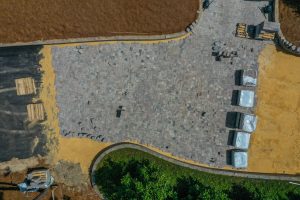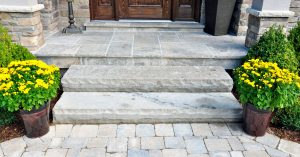






The choice between open-graded and dense-graded bases for Lowcountry driveways depends on drainage needs and soil stability. Dense-graded bases, composed of crushed stone and “fines,” offer maximum load-bearing strength for heavy vehicles. Open-graded bases, using larger, uniform stones without fines, provide 30–40% void space for superior drainage—making them the ideal solution for Lowcountry properties with high water tables or strict stormwater regulations.

Understanding the Foundation: Dense-Graded vs. Open-Graded
To the naked eye, a paver driveway is all about the stone on top. But in the engineering world, the driveway is only as stable as the “base” underneath. In our coastal environment, we typically see two distinct approaches:
1. Dense-Graded Bases (The Traditional Standard)
A dense-graded base consists of a mixture of various stone sizes, including “fines” (stone dust). When compacted, these fines fill the gaps between the larger stones to create a solid, impermeable mat.
- Best For: Heavy-traffic driveways and areas with stable, well-draining sub-soils.
- The Benefit: Offers the highest possible PSI (pounds per square inch) support.
- The Risk: In the Lowcountry, if water gets trapped between the pavers and a dense base, it has nowhere to go. This can lead to “pumping” (sand washing out) or shifting during our heavy summer thunderstorms.
2. Open-Graded Bases (The Coastal Solution)
Open-graded bases use “clean” stone—meaning all the stones are roughly the same size with no dust or fines. This creates significant “void space” (gaps) between the rocks.
- Best For: Low-lying areas, pool decks, and properties subject to strict impervious surface limits.
- The Benefit: It acts as an underground reservoir. Rainwater filters through the paver joints and is stored in the base until it can naturally soak into the ground.
- The Technical Edge: Open-graded bases are virtually unaffected by the “freeze-thaw” cycle (though rare here) and, more importantly, are not susceptible to the saturated-soil shifting common in Bluffton.
Why Base Choice Matters

Our geography presents two specific challenges that the “Science of Stability” must solve:
The High Water Table
In many parts of Beaufort County, the water table is just a few feet below the surface. A Dense-Graded Base can act like a dam, causing water to pool under your pavers. An Open-Graded Base allows that water to move vertically and laterally, keeping your driveway surface dry and stable.
Stormwater Compliance
As of 2026, many local Architectural Review Boards (ARBs) are tightening rules on “impervious cover.”
Scientific Fact: An open-graded base paired with permeable pavers can reduce surface runoff by up to 100% during a standard rain event. This often allows homeowners to build larger patios or driveways than traditional concrete would allow.
Comparative Analysis: Which Is Right for You?
| Feature | Dense-Graded Base | Open-Graded Base |
| Primary Material | Crushed Stone + Fines (CR-6 / GAB) | #57 Stone + #89 Stone |
| Drainage Speed | Low (Surface Runoff) | High (Infiltration) |
| Compaction Strength | Exceptional | High |
| Installation Speed | Moderate | Faster |
| Cost | Standard | Slightly Higher |
Frequently Asked Questions (FAQ)
Actually, no. Because there are no “fines” (soil-like particles) in an open-graded base, there is no organic medium for seeds to take root. When paired with high-quality polymeric sand or specialized joint chips, weed growth is significantly reduced.
Absolutely. When properly engineered and with the correct depth of #57 stone, an open-graded base meets the same load-bearing requirements as traditional road bases.
It requires different maintenance. To keep the drainage “open,” you should occasionally sweep or vacuum the joints to prevent debris from clogging the infiltration paths.
Your New Outdoor Living Project Starts Here
Building a custom outdoor living space is about more than just pavers and sand – it’s about creating a foundation for memories that last a lifetime. Whether you are ready to break ground on a gourmet outdoor kitchen in Charleston, design a heat-resistant pool deck in Bluffton, or navigate the specific drainage requirements of Hardeeville, the team at Lowcountry Paver is here to guide you every step of the way.
Ready to transform your outdoor lifestyle? Our experts are available to answer your technical questions, provide product samples, or connect you with a vetted LCP Preferred Installer in your neighborhood. Let’s build an outdoor lifestyle that stands the test of time.
- Visit Our Showroom: 535 Stiney Road, Hardeeville, SC 29927
- Call Us Toll-Free: 843-704-7104
- Send Us An Email: [email protected]
- Get A Quote: LCPaver.com/Quote