





The longevity of a paver installation is determined almost entirely by its base preparation, not the pavers themselves. In the Lowcountry, a professional base requires 6 to 12 inches of compacted aggregate—typically #57 stone or GAB (Graded Aggregate Base). Without this structured foundation, even the highest-quality pavers will eventually sink, shift, or “rut” under the weight of vehicles and the movement of coastal groundwater.

The 85% Rule of Hardscaping
In the industry, we often say that a paver project is 15% what you see and 85% what you don’t. While the color and pattern of your Lowcountry Pavers provide the curb appeal, the base material provides the structural integrity.
The Anatomy of a Lowcountry Base
Because of our sandy soils and high water table in Bluffton and Hilton Head, a “standard” DIY base often fails. A professional-grade foundation consists of four critical layers:
- The Subgrade (Excavated Soil): We dig 8″ to 14″ deep, removing organic matter and loose topsoil to reach stable ground.
- Geotextile Fabric (The “Separation” Layer): This is the most skipped step in amateur installs. This heavy-duty fabric prevents your expensive stone base from sinking into the soft South Carolina sand over time.
- The Compacted Aggregate Base: We use Crushed Stone or GAB (Graded Aggregate Base). Unlike rounded pea gravel, these angular stones “lock” together when compacted with a 5,000-lb force plate compactor.
- The Bedding Layer: A 1-inch layer of washed concrete sand or fine stone chips. This acts as the “setting bed” that allows us to level each paver perfectly.
Why Driveways Need 2x the Base of a Patio
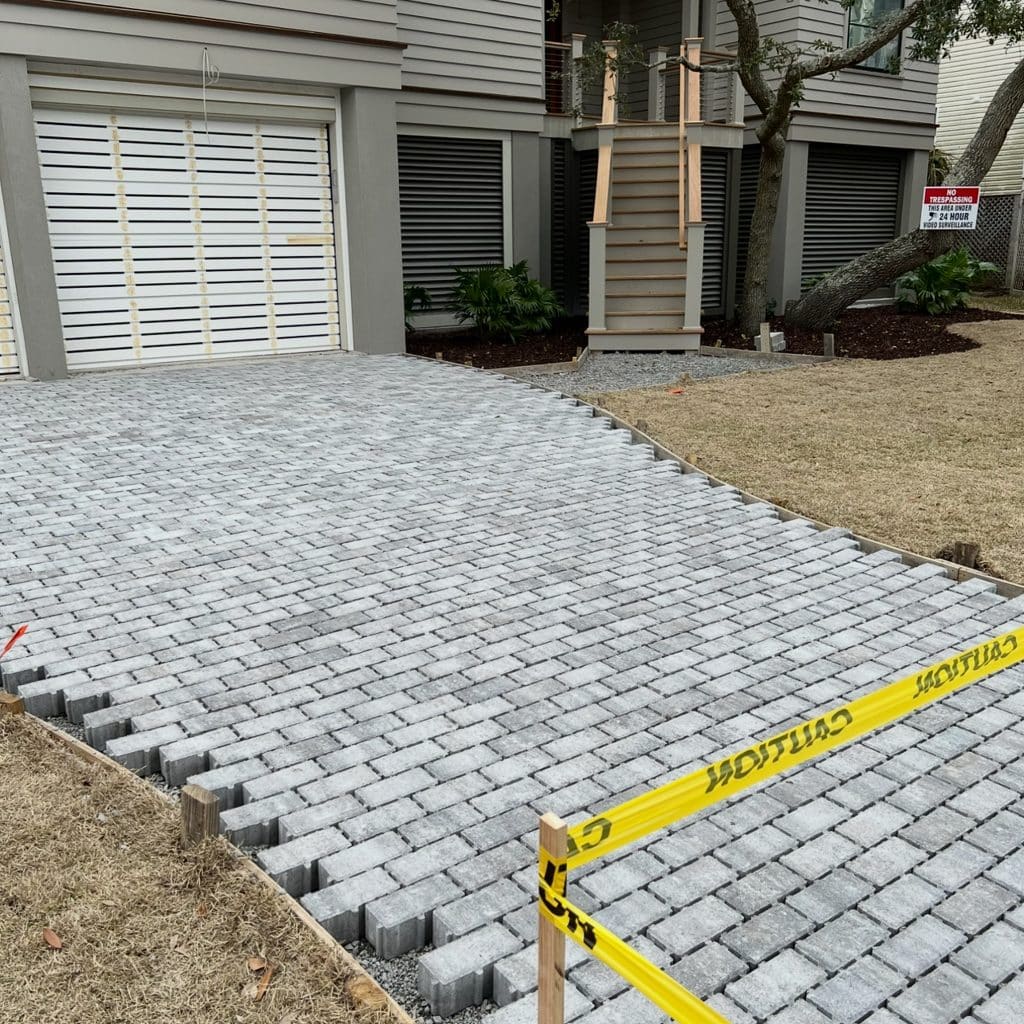
The primary cause of driveway “rutting”—those tire-shaped indentations—is an insufficient base.
| Project Type | Minimum Base Depth | Recommended Material |
| Pedestrian Patio | 4 – 6 Inches | Compacted Crushed Stone |
| Residential Driveway | 8 – 12 Inches | Graded Aggregate Base (GAB) |
| Commercial Parking | 12+ Inches | High-Density Engineered Base |
The “Sand Trap”: Why Stone Dust is a Coastal No-Go
Many contractors still use “stone dust” or “screenings” as a base because it’s cheap and easy to level.
- The Problem: Stone dust holds water. In our humid climate, a stone dust base stays saturated, which can lead to efflorescence (white salt stains) on your pavers and, eventually, a “mushy” foundation that causes pavers to tilt.
- The Solution: Use washed sand or open-graded stone. These materials allow water to pass through freely, keeping your base dry and your pavers locked tight.
Expert Insight: “If your contractor doesn’t mention ‘compaction in lifts,’ be wary. We compact our base every 2 to 3 inches. If you dump 8 inches of stone and compact it once, only the top 2 inches actually get hard. The bottom 6 inches will settle later—taking your driveway down with it.”
Frequently Asked Questions (FAQ)
Most soil in the Bluffton/HHI area is sandy, which is actually great for drainage but poor for “holding” weight. This is why the proper base depth and compaction are non-negotiable for our region.
Yes. Roots from Live Oaks or Palmettos can exert massive upward pressure. If you are building near large trees, we recommend installing a root barrier during the excavation phase to protect your investment. The good news: if a tree root causes problems for your pavers, it’s completely repairable.
Yes, but it’s the cheapest insurance policy you can buy. The cost of adding 2 extra inches of stone during installation is a fraction of the cost of “unzipping” and re-leveling a sunken driveway five years later.
Your New Outdoor Living Project Starts Here
Building a custom outdoor living space is about more than just pavers and sand – it’s about creating a foundation for memories that last a lifetime. Whether you are ready to break ground on a gourmet outdoor kitchen in Charleston, design a heat-resistant pool deck in Bluffton, or navigate the specific drainage requirements of Hardeeville, the team at Lowcountry Paver is here to guide you every step of the way.
Ready to transform your outdoor lifestyle? Our experts are available to answer your technical questions, provide product samples, or connect you with a vetted LCP Preferred Installer in your neighborhood. Let’s build an outdoor lifestyle that stands the test of time.
- Visit Our Showroom: 535 Stiney Road, Hardeeville, SC 29927
- Call Us Toll-Free: 843-704-7104
- Send Us An Email: [email protected]
- Get A Quote: LCPaver.com/Quote